

One of the pillars of the project is the expansion of analytical infrastructure to transfer the solution from research to diagnostic practice. The purchase of equipment was focused on: (1) high sensitivity and repeatability of measurements, (2) the possibility of standardization and regulatory compliance (IVDR), and (3) process automation, limiting operator variability.
UPLC-MS/MS + DESI ion source (MS imaging)
The ultra-high-performance liquid chromatography system with a tandem mass spectrometer enables quantitative determination of nucleoside modifications in DNA/RNA with high selectivity and sensitivity. It is crucial for the project that the solutions can be implemented in routine diagnostics, which is why compliance with the requirements of IVDR (EU 2017/746) for in vitro diagnostic devices is an important criterion.
The infrastructure also includes a DESI (Desorption Electrospray Ionization) ion source, which supports mass spectrometry imaging and surface analysis. This set expands research capabilities in the direction of spatial analysis and biomarker validation in tissue materials, while strengthening the laboratory’s translational potential.
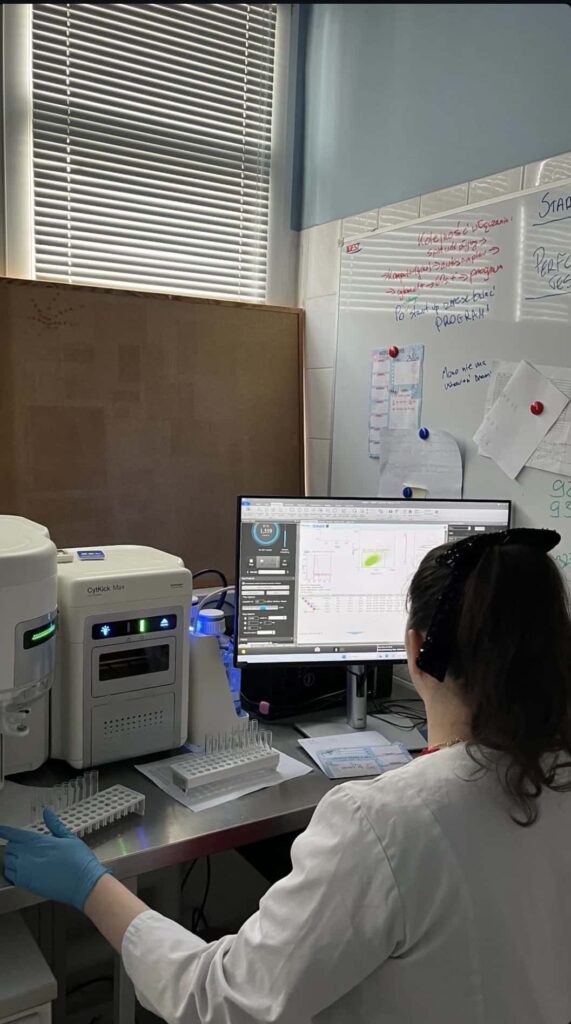
Imaging flow cytometer (Attune CytPix)
The purchased cytometer enables simultaneous multiparametric fluorescence analysis and cell image recording. In the context of the project, the imaging function has practical significance: it allows for the verification of cell populations collected during analysis, the exclusion of aggregates and artifacts, and additional control of the specificity of intracellular staining – particularly important when procedures involve steps that may affect receptor conformation. The combination of cytometry and imaging supports standardization and increases the reliability of results.
Andrew+ + OneLab robot (automation and traceability)
Andrew+ is a modular robotic system for precise liquid handling and automation of multi-step laboratory procedures. It uses certified electronic pipettes as working effectors, which allows for continuity between manual and automated protocols while reducing operator variability. The platform has an open, configurable architecture (“Dominos” modules), allowing it to work with standard consumables and integrate executive modules (e.g., heating/mixing).
An integral part of the system is the OneLab environment, which enables graphical protocol design without programming and a full audit trail: protocol versioning, execution parameter log, date/time, operator, and change history. This is particularly important in the context of method validation, comparison of experimental series, and quality system requirements (GLP/GxP).
Infrastructure benefits
- Greater repeatability and shorter sample preparation time thanks to automation.
- Higher sensitivity and selectivity of nucleic acid modification assays (UPLC-MS/MS).
- Additional quality control of cytometric data thanks to cell imaging.
- Simplified validation and traceability of processes thanks to OneLab.
Flow Cytometer

UPLC‑MS/MS
